
Guide to membranes for a ventilated roof
Published on 10.08.2026 · Isoflect Insulation technical team
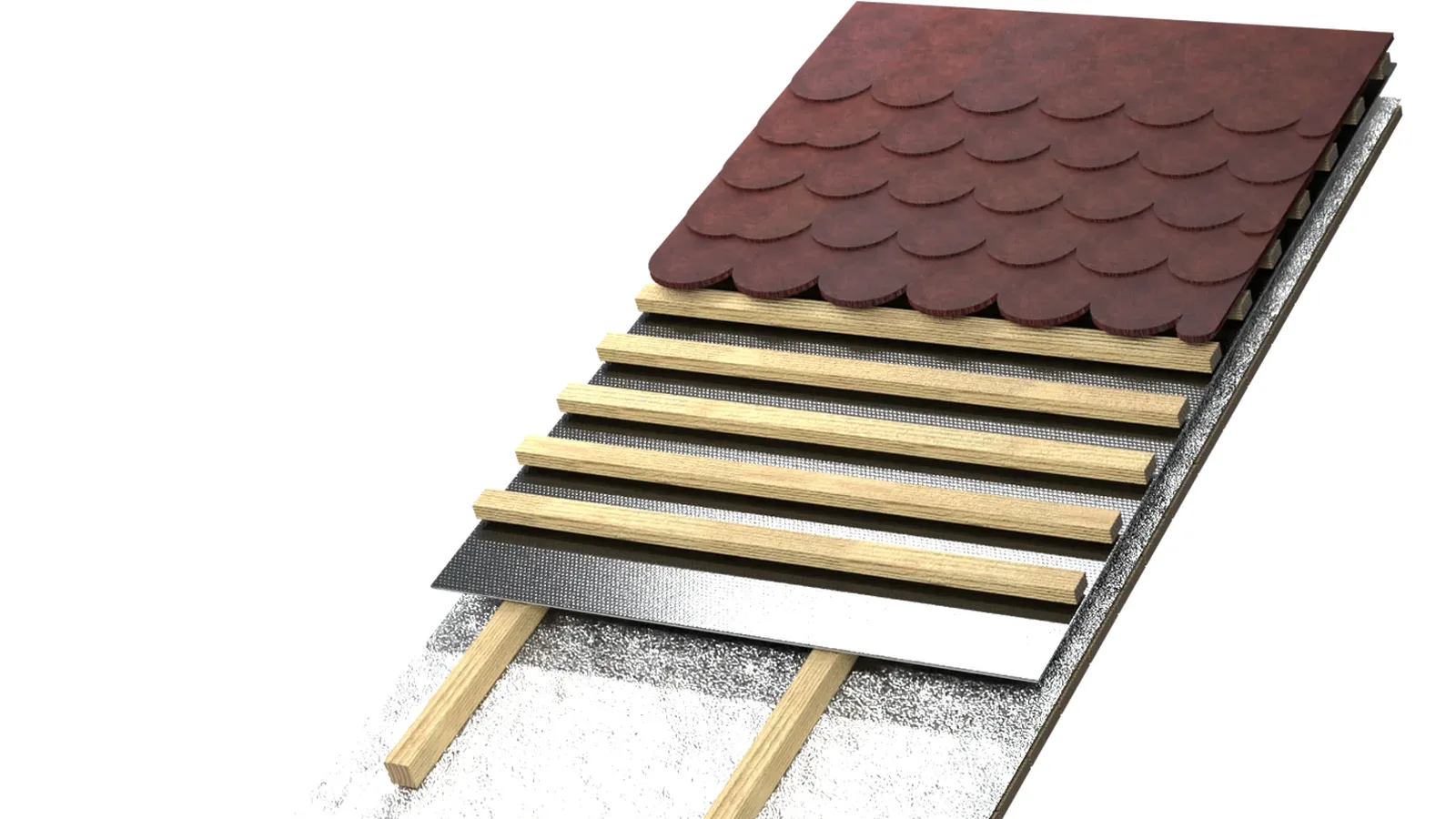
A habitable attic that is cold in winter, too warm in summer or with damp patches on the finishes often has a hidden cause between the rafters and the roof covering. This guide to membranes for a ventilated roof explains the role of each layer and how to build a system that removes moisture in a controlled manner, reduces heat losses and protects the timber in the long term.
A ventilated roof does not simply mean a roof covering installed over roof boarding. It is an assembly in which air must circulate correctly beneath the roof covering, incidental water must be drained towards the eaves, and the vapour generated indoors must be kept under control. When a membrane is missing or its joints are not sealed, the risk is not only visible condensation. Deterioration of the thermal insulation, mould, corrosion of metal components and costly interventions may occur after the habitable attic has already been finished.
How a ventilated roof works
On a pitched roof, the ventilation space is usually created between the membrane installed beneath the roof covering and the roof covering material. The counter-battens form the air channel, while the battens support the tiles, metal sheeting or other external finish. Air enters at the eaves, rises along the pitch and exits at the ridge. This circulation helps remove moisture and limit overheating of the outer layer.
Beneath the roof covering, the diffusion membrane is the first line of protection against water that may penetrate through joints, under the action of wind or as a result of condensation beneath metal sheeting. It must be watertight, yet sufficiently vapour-permeable for moisture in the structure to migrate outwards.
On the warm side of the thermal insulation, towards the interior of the habitable attic, a vapour control membrane or a vapour barrier is installed, selected according to the system. Its role is to limit the amount of vapour that penetrates the wool insulation and the roof structure. Between these two membranes lies the thermal insulation, for example mineral wool or eco-friendly wool, installed without gaps between the rafters and, where the design permits, in an additional layer beneath the rafters.
The principle is simple: the exterior must be able to release vapour, while the interior must be airtight and vapour-controlled. In practice, performance depends on the details.
Guide to membranes for a ventilated roof: what to choose
There is no universal membrane for every roof. The correct choice depends on the type of roof covering, the pitch, the presence of roof boarding, the use of the attic, the thickness of the thermal insulation and the local climate. For a habitable attic, where indoor humidity rises through cooking, showers and daily activities, vapour control becomes essential.
The diffusion membrane beneath the roof covering
A diffusion membrane is installed on the outside of the thermal insulation, beneath the counter-battens and the roof covering. In a modern system, a highly vapour-permeable membrane may be laid directly over the thermal insulation or over the roof boarding, in accordance with the manufacturer's instructions. In this way, a ventilation gap between the wool insulation and the membrane is no longer necessary, but the ventilated channel above the membrane remains necessary.
Consider several specific characteristics: water resistance, vapour permeability, frequently expressed by the Sd value, mechanical tear resistance and behaviour under UV radiation during installation. A low Sd value generally indicates a better capacity to release vapour. The membrane must also be chosen according to its compatibility with the roof covering. Beneath metal sheeting, where temperature variations and condensation are more pronounced, anti-condensation protection and correct ventilation become priorities.
Vapour barrier or smart membrane
On the inner face of the insulation, do not automatically choose the least permeable membrane. A vapour barrier with a high Sd value may be appropriate in certain configurations, but in an existing roof, with timber that may contain residual moisture, a membrane with variable vapour behaviour may be a safer option. It limits vapour diffusion in winter and allows controlled drying towards the interior under certain summer conditions.
The difference is relevant particularly in renovations. If the structure is old, if you cannot verify all the existing layers or if the roof covering will not be removed, a technical assessment of the assembly reduces the risk of trapping moisture in the timber. In new construction, with clearly defined layers and controlled workmanship, the solution can be more straightforward.
A reflective membrane can contribute to the control of thermal radiation when installed in the correct configuration, with the air space required for the reflective function. However, it does not automatically replace bulk thermal insulation, nor the diffusion membrane beneath the roof covering. Each layer must have a clear function, not merely add thickness to the system.
Tapes and sleeves are not optional accessories
A high-performance membrane perforated by cables, pipes or spotlights and left unsealed loses an important part of its function. Airtightness is achieved with compatible tapes, adhesives for overlaps and sleeves for penetrations. These details stop the flow of warm, humid air towards the cold areas of the roof, where it may condense.
It is useful to regard this layer as the inner envelope of the habitable attic. If air passes through joints in an uncontrolled manner, heat losses increase, and the amount of moisture transported can be much greater than that transmitted slowly by diffusion.
The correct order of layers
For an insulated habitable attic beneath a ventilated roof, the usual sequence, from the exterior to the interior, is: roof covering, battens and counter-battens creating the ventilation, diffusion membrane, thermal insulation between and possibly beneath the rafters, sealed vapour control membrane, service void and interior finish. Roof boarding may be present between the diffusion membrane and the timber structure, depending on the construction solution.
The service void between the inner membrane and the plasterboard is worth planning. Electrical installations can be routed here without repeatedly perforating the sealing layer. It is a simple decision that increases the predictability of the work and reduces the time subsequently spent on repairs.
In the case of a non-accessible, unheated attic, the strategy may change. It is often more efficient to insulate the attic floor rather than the roof slopes. The roof remains ventilated and cold, and the heated volume of the house is reduced. If the attic is later converted into a habitable space, the system must be completely reassessed.
Installation details that make the difference
The diffusion membrane is installed with overlaps in accordance with the pitch and the technical recommendation for the product. On low pitches, in areas exposed to wind or in regions with heavy precipitation, the overlap and bonding details become even more important. Water must be directed outwards, not towards the roof boarding or the rafter ends.
At the eaves, the air inlet must be protected against insects and birds without being blocked. At the ridge, the air outlet must be kept clear, including after the roof covering accessories have been installed. A ventilation channel interrupted by insulation, foam or components installed in an uncontrolled manner no longer functions as designed.
Around chimneys, roof windows, dormers and pipe penetrations, the outer membrane is detailed so that water is diverted outwards. Most leaks occur around these areas, not on the continuous surface of the roof. On the interior, the same penetrations must be sealed with sleeves and tapes suited to the type of substrate.
Avoid overstretching the membranes. The material must be stable, yet allow small movements of the structure to be accommodated and water to drain towards the eaves. Likewise, do not leave the membranes exposed to the sun for longer than the period permitted by the manufacturer. Temporary UV resistance does not mean permanent protection.
Frequent errors and their real cost
The most common error is confusing the diffusion membrane with the interior membrane. A membrane of low permeability installed beneath the roof covering can prevent the structure from drying outwards. Equally risky is installing a diffusion membrane on the interior, in place of an airtight vapour control layer.
Another mistake is compressing the thermal insulation or leaving gaps at the rafters, at the ridge and around windows. Insulation works by means of the air trapped within its structure. When it is compacted or interrupted, the thermal resistance decreases and thermal bridges appear.
Last but not least, roof ventilation does not compensate for a lack of interior airtightness. If humid air from the dwelling continuously reaches the thermal insulation through joints, the amount of moisture may exceed the drying capacity of the system. A safe roof works as an assembly, not as a collection of separately installed membranes.
For assured and predictable performance, calculate the system before ordering: the type of roof covering, the actual surface area including overlaps, the insulation thickness, the position of building services and all detail areas. Isoflect can assist in configuring a package adapted to your habitable attic or unheated attic, so that the membranes, tapes and thermal insulation work together. A technical discussion before installation is much simpler than removing a finish after the first cold season.
Not sure which Isoflect product suits you? See Reflectiva Roof Pro or open the package configurator to find out exactly what you need and in what quantity.