
Roof condensation: causes and correct prevention
Published on 16.08.2026 · Isoflect Insulation technical team
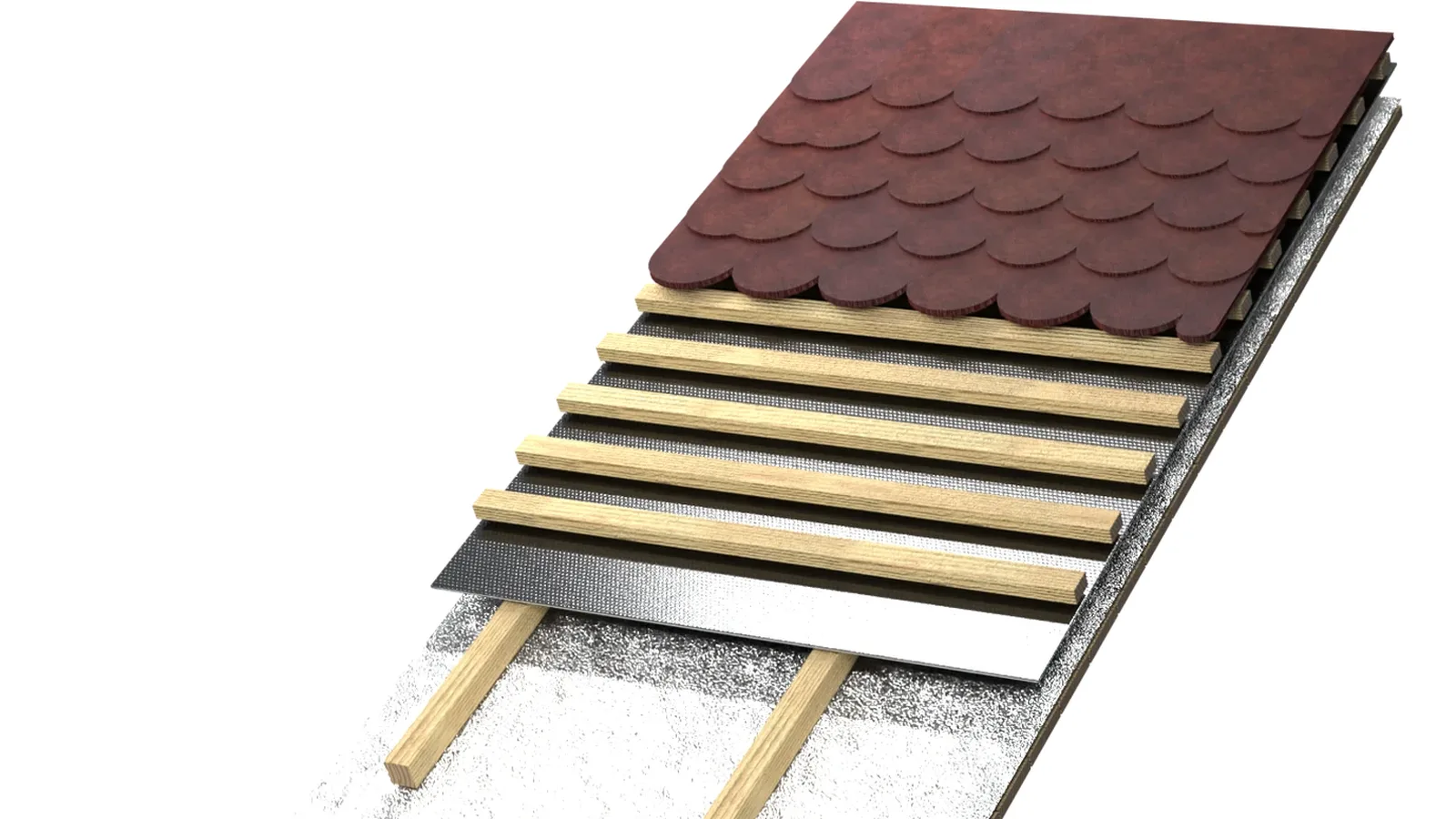
Water droplets on the membrane in the attic, a persistent smell of damp or black stains in the corners of the habitable attic are not mere seasonal inconveniences. The problem frequently referred to as roof condensation causes is almost always related to the manner in which vapour from the interior circulates, meets cold surfaces and becomes trapped in the roof structure. If the phenomenon recurs, the timber may accumulate moisture, the thermal insulation may lose some of its performance, and repairs become more costly than the correct installation of a complete system from the outset.
A healthy roof does not simply mean correctly installed tiles, metal sheet or shingles. It is an assembly in which the roof covering, the diffusion membrane, the ventilation space, the insulation, the airtightness and vapour control must work together. A single incorrectly chosen component can shift the problem from one area to another.
How condensation forms beneath the roof
Warm air can hold more water in the form of vapour than cold air. In a dwelling, vapour originates from ordinary activities: cooking, showers, drying laundry, breathing or plants. When this air reaches the cold zone of the roof through joints, cracks or unsealed materials, its temperature falls. At the dew point, the vapour turns into liquid water.
In the cold season, the difference between the heated interior and the exterior is large. For this reason, droplets may appear beneath the roof covering or on the cold side of a membrane, sometimes mistaken for a leak. The difference matters: a leak generally appears after rain, snowmelt or strong wind, whereas condensation may appear even in dry weather, particularly in the morning or after periods of high indoor humidity.
A small quantity of moisture, managed by a diffusion membrane and correct ventilation, can be removed. Problems arise when moisture enters the structure faster than the structure can dry out.
Roof condensation: the most frequent causes
Vapour barrier missing or installed on the wrong side
In a roof insulated on the interior side, the vapour barrier or vapour control layer is normally positioned on the warm side of the thermal insulation. Its role is to limit the penetration of vapour from the room into the wool and into the cold zone of the structure.
If this layer is missing, excessively perforated or has unsealed joints, moist air penetrates through the smallest gaps. It is not sufficient for the membrane to be present. Overlaps, edges, cable penetrations, light fittings and the connection with the walls must be sealed with compatible accessories. A good membrane, carelessly installed, may yield poor results.
There are also systems with membranes of variable vapour behaviour, useful in certain build-ups. The choice depends on the type of roof, the thickness of the insulation, the ventilated spaces and the capacity of the assembly to dry out. Not every membrane is suitable for every habitable attic.
Unsuitable diffusion membrane beneath the roof covering
Beneath tiles, metal sheet or other roof coverings, the diffusion membrane has a function different from that of the vapour barrier. It protects the thermal insulation and the structure from water that may accidentally penetrate beneath the roof covering, while allowing vapour to escape from the interior towards the exterior, within the limits of its specifications.
An anti-condensation membrane chosen without taking into account the roof pitch, the type of roof covering and the ventilation space may retain moisture where controlled drying ought to take place. Moreover, the membrane should not be confused with a mere waterproof material. A layer that is completely impermeable to vapour, incorrectly positioned, can turn the roof into a closed space, with a high risk of interstitial condensation.
On metal-sheet roofs, the details are even more sensitive. Metal sheet cools rapidly, and temperature variations can produce condensation on its underside. A predictable solution must combine the appropriate layer beneath the roof covering with ventilation and vapour control from the interior.
Insufficient ventilation between the membrane and the roof covering
Air must be able to circulate beneath the roof covering from the eaves towards the ridge. This ventilation channel contributes to the removal of moisture and to the reduction of overheating in the warm season. If the air inlet at the eaves is blocked by insulation, if the path is interrupted or if the outlet at the ridge is missing, moisture remains trapped beneath the roof covering.
Ventilation does not mean random gaps in the thermal insulation. These produce uncontrolled air currents and heat losses. What is needed is a continuous path, sized for the roof configuration, separated from the thermal insulation layer and protected against birds, insects or accumulations of leaves.
Thermal insulation installed with gaps or insufficient thickness
Cold zones in the roof are favourable points for condensation. If the insulating wool is compressed, interrupted at the rafters or installed with joints, the temperature on the interior side of the structure may fall below the safe level. This creates the risk of local condensation, even if the rest of the habitable attic appears well executed.
The thickness of the insulation is determined by calculation, not by how much space remains between the rafters. What matters is the thermal conductivity (Lambda) of the material, the thermal bridges created by timber or metal, the local climate and the intended use of the space. A habitable attic that is permanently heated has different requirements from a cold, ventilated attic.
In many projects, a two-layer build-up reduces continuous joints and limits thermal bridges. Ecological wool, reflective membranes or other materials can form part of an efficient system, but only when their position and the required air spaces are respected in accordance with the technical data sheet.
Excessive indoor humidity and poor ventilation of the dwelling
Sometimes the roof is correctly executed, but the house produces more vapour than it can remove. A renovated, airtight and efficiently heated dwelling requires disciplined airing or appropriate mechanical ventilation. Double-glazed windows without additional ventilation reduce heat losses, but may retain moisture indoors.
Monitor relative humidity with a hygrometer. In winter, the values must be adjusted in relation to the indoor temperature and the performance of the windows, in order to avoid condensation on cold surfaces. If the windows mist up frequently, the problem may already be large enough for vapour to migrate towards the roof as well.
How to tell whether it is condensation or a leak
Condensation often appears uniformly, in the form of droplets on the underside of the membrane or on metal elements. The timber may show diffuse stains, and the dampness may become more pronounced after cold nights without precipitation. Leaks tend to be concentrated near a chimney, a roof window, a penetration, a sheet-metal joint or a deteriorated area of the roof covering.
The inspection should be carried out in dry weather and after rain. Observe whether the water follows the line of a slope, whether there are traces beneath fixings and whether the membrane is torn or has been left without the necessary overlap. In practice, both problems may exist simultaneously: a small leak can wet the insulation, and damp thermal insulation further cools the area and promotes condensation.
The correct system: vapour control, insulation and ventilation
The durable solution is not to perforate the membrane further or to add a single layer at random. The first step is to identify the existing build-up: ventilated or unventilated roof, habitable attic or cold roof space, type of roof covering, thickness and condition of the insulation, as well as the presence of a vapour barrier.
For an insulated habitable attic, the principle is clear: towards the interior, a continuous vapour control and airtightness layer is created; in the middle zone, the thermal insulation is installed without gaps; towards the exterior, a diffusion membrane compatible with the system is used, followed by the ventilation channel and the roof covering. Every penetration through the layers must be treated carefully, from cables and pipes to roof windows.
For a cold roof space, the insulation is generally placed at the level of the ceiling slab, and the roof space remains ventilated. Insulating directly along the roof pitch, without a strategy for the vapour from the dwelling and for the ventilation of the roof space, may create a zone with unpredictable behaviour.
Isoflect recommends selecting materials as a functional package, not as isolated products. A membrane, a sealing tape and a thermal insulation material must be assessed together, since the final performance depends on the continuity of the system. Technical consultancy before ordering can prevent incompatibilities that are simple but costly at the installation stage.
What to do before any intervention
Do not close up a roof that already has damp timber or saturated wool insulation. The affected materials must be inspected, and the source of the moisture must be eliminated before the layers are rebuilt. Timber with extensive mould, damaged membranes and thermal insulation that has lost its shape or is soaked must not be concealed beneath new finishes.
Request clear data on the thickness, Lambda conductivity, vapour permeability, diffusion resistance and field of application of each product. Equally important is the plan for joints and penetrations. It is the small details that separate a warm, dry habitable attic from one that requires repairs after the first winter.
A condensation-free roof is not achieved through a single miracle membrane. It is achieved through a controlled path for heat, air and vapour, constructed intelligently, safely and adapted precisely to the structure of your house.
Not sure which Isoflect product suits you? See Reflectiva Roof Pro or open the package configurator to find out exactly what you need and in what quantity.