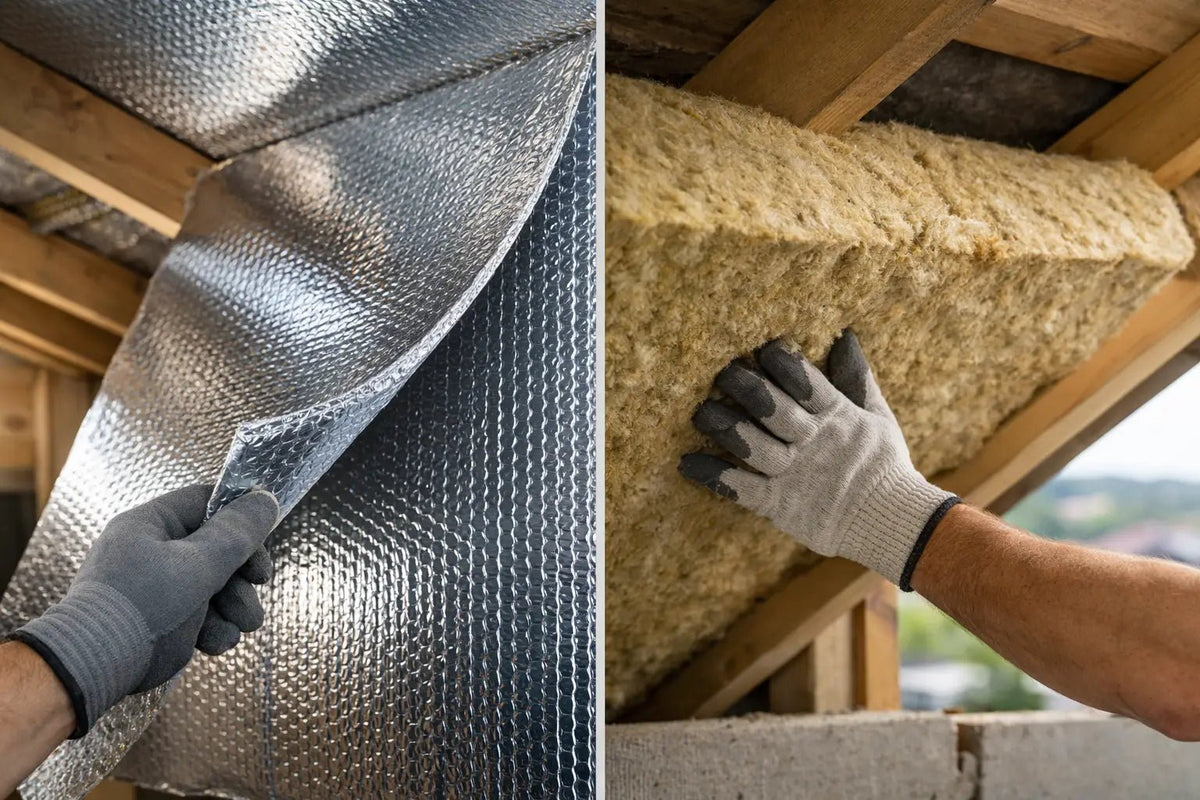
An attic can have a thick layer of insulation in winter and still lose heat through air leaks or develop condensation behind the finish. This is where the "reflective insulation versus mineral wool" comparison only becomes useful if you look at the whole system: heat transfer, moisture vapor, available space, noise, and how the installation is actually done in practice. The two materials don't solve exactly the same problem, and in many projects they work better together than apart.
Reflective insulation versus mineral wool: the difference in principle
Mineral wool is a fibrous insulation made from mineral fibers. It slows heat transfer through its thickness and through the air trapped between its fibers. Its thermal performance is expressed as an R-value in the US market or as lambda and thickness on European technical data sheets. The thicker the layer and the better it's installed, without gaps, the higher the assembly's thermal resistance.
Reflective insulation, usually a membrane with metallized surfaces, works differently. It reduces radiant heat transfer when facing an air space. At the same time, certain membranes can also contribute to air sealing and vapor control, depending on their declared permeability, taped seams, and their position within the wall or roof.
So a reflective membrane should not be evaluated as an automatic substitute for 6 or 10 inches of mineral wool. If it's pressed directly between two solid layers, without an air gap, the reflective effect drops significantly. On the other hand, a properly installed membrane can add a function that wool alone doesn't offer: predictable control of air leakage and vapor movement.
Thermal performance: thickness or radiation?
In climates with cold winters, insulation thickness remains essential. Mineral wool is a solid choice for wall cavities, between rafters, floors and ceilings, because it provides measurable thermal resistance throughout the material's volume. For a roof or a livable attic, the wool layer should be sized according to climate, structural depth, and local building code.
Reflective insulation is especially valuable where solar load and radiant heat matter most. Under a metal roof, in ventilated attics, on lightweight construction walls, or in certain HVAC applications, it can limit radiant heat from hot surfaces. In hot, sunny states, this can reduce summer discomfort in an attic or loft.
Still, the promise of "a thin insulation that replaces everything" should be viewed carefully. A membrane a few millimeters thick doesn't provide the same conductive protection as a solid layer of mineral wool. The right result comes from the configuration: an insulating layer for thermal resistance, an air space where the reflective function is needed, and careful sealing so conditioned or heated air doesn't escape through joints.
What matters in attics and lofts
In a finished attic, the space between rafters is limited and every inch counts. Mineral wool fills the cavity and also helps reduce outside noise . A reflective membrane can be positioned as part of a vapor control and air-sealing system, but which face it's installed on depends on the local climate and the complete roof assembly.
In an unfinished attic, the strategy can be different. Often the main insulation sits on the floor toward the living space, while the attic itself stays ventilated. In that case, a reflective film under the roof covering can help control radiant heat without replacing the insulation on the ceiling of the top floor.
Moisture, condensation and sealing
The most costly mistakes don't always come from a missing R-value, but from moisture trapped in a roof or wall. Warm indoor air carries moisture vapor. When it reaches a cold surface in the structure, the vapor can condense. Over time, wood can deteriorate, and mold and unpleasant odors can affect comfort and the health of the home.
Mineral wool is vapor-permeable and is not a vapor barrier. That can be an advantage in an assembly designed to dry out in a controlled way, but it also means it needs a separate strategy for air and vapor control. It's not enough to pack the wool tightly between the rafters if the joints around skylights, cable penetrations, or chimneys are left unsealed.
Reflective membranes can act as a vapor barrier, a vapor retarder, or a variable-permeability layer, depending on the product. Not all films are the same. Always check vapor permeability, tear resistance, compatibility with sealing tapes , and the installation guidance for your project's climate.
A vapor barrier installed on the wrong side can block a structure from drying out. In mixed climates, in areas with strong air conditioning, or in a home with high indoor humidity, this detail becomes even more sensitive. This is where technical advice before installation is cheaper than repairing a roof damaged by condensation.
Sound insulation and fire safety
If the goal includes quiet between bedrooms, protection from rain noise on a metal roof, or reducing street noise, mineral wool has a clear advantage. Its dense, fibrous structure absorbs sound energy and reduces reverberation in cavities. For interior walls, floors between levels, and attics, it's a material with real acoustic benefits.
A reflective membrane is thin and cannot substitute for the mass and absorption of mineral wool. It can support a well-sealed system, and sealing does help indirectly with airborne noise, but it isn't a primary acoustic solution.
Mineral wool is also valued for its behavior at high temperatures. The exact fire classification should be checked in the product documentation and matched against local requirements. Reflective film has different characteristics and should be chosen according to the certifications for its intended use, especially near heat sources, ducts, or HVAC equipment.
Installation decides the outcome
A good material installed carelessly produces unpredictable results. With mineral wool, pieces need to be cut precisely so they fill the cavity without being overly compressed. Compression can reduce the usable thickness and the thermal performance. Gaps around the framing, ducts, and electrical boxes need to be handled carefully.
With reflective insulation, continuity is critical. Seams overlap according to the instructions and are sealed with compatible tape. Penetrations for cables, pipes, or fasteners must be resolved with proper sealing details, not ignored. And if the system needs an air space, it must be maintained on the active reflective surface.
For renovations, a membrane's reduced thickness can be decisive when you don't want to lose interior space. For new construction or a deep renovation, where cavities are available, mineral wool offers an efficient way to build thermal resistance and acoustic comfort. Don't compare only the price per roll or per package. Compare the cost per surface area, the final thickness, the sealing accessories, the installation time, and the functions the assembly needs to perform.
When to choose one, when to choose a mixed system
Choose mineral wool when you need consistent R-value, sound absorption, and to fill wall, floor, or roof cavities. It's an efficient base for a well-sized thermal envelope.
Choose a reflective membrane when you need to reduce radiant heat, build a continuous sealing layer, or manage vapor according to the project's design. It's especially practical under roof coverings, in attics, on lightweight structures, and in areas where available thickness is limited.
Choose the combination when the project calls for absolute comfort, not a single good number on paper. Wool can control heat transfer and noise, while the membrane can support sealing and moisture management. Isoflect Insulation can help configure a package suited to the installation area, but the final decision should be based on the local climate, the building code, and the actual structural details.
Before you order, note where the insulation will go, what space you have available, whether the area is ventilated, what interior finish will follow, and where thermal bridges might appear. These answers turn the material choice into an innovative, smart, and safe system, capable of protecting the home for the long term.