
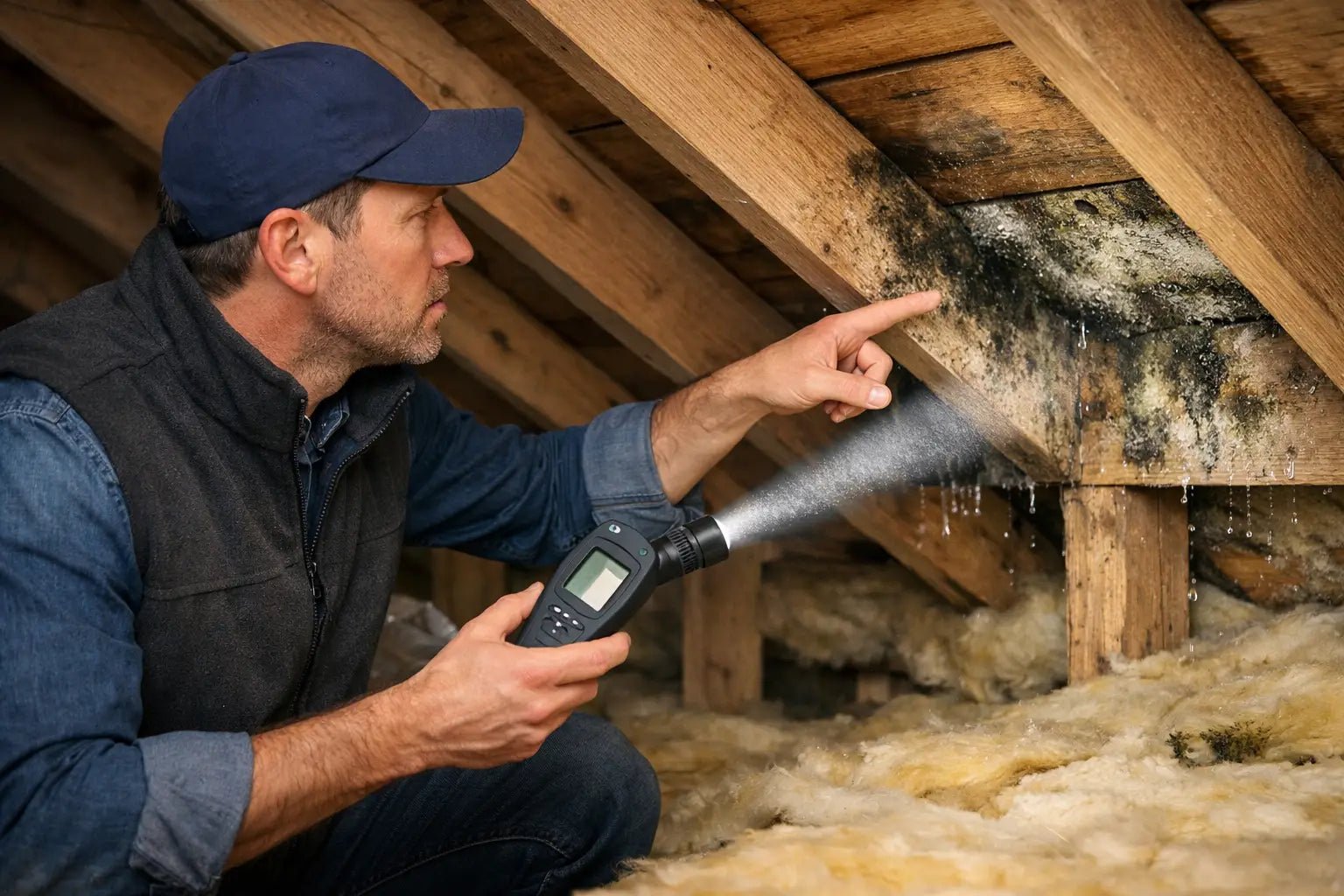
Black spots on the sheathing, a persistent damp smell, or damp thermal insulation aren't just cosmetic problems. In an attic, they usually indicate an imbalance between the warm, humid air from the home, the cold roof surfaces, and insufficient moisture removal. If you want to know how to prevent mold in the attic, you need to treat the whole roof as a system: covering, ventilation, insulation, membranes, and sealing.
Mold doesn't appear because the attic is cold. It appears when water vapor reaches cold zones, condenses, and keeps the wood or insulation damp for long periods. The right approach reduces the risk of structural decay, heat loss, and costly roof repairs.
Why mold appears in an attic
A lived-in house constantly produces water vapor: from showers, cooking, laundry, drying clothes, or even breathing. In winter, warm indoor air can carry more moisture. If this air passes through the ceiling into the attic and meets a cold surface, such as the sheathing or the underside of the roof covering, condensation can form.
The problem is common in unfinished attics insulated at the floor level, but it also occurs in livable lofts. The difference is that in a cold attic, the insulation is usually on the floor, and the space under the roof covering must be ventilated. In a loft, the roof layers must be carefully designed so vapor is controlled and any accidental moisture can be evacuated.
The most common causes are leaks through the roof covering, a missing vapor barrier or one installed without a proper seal, insufficient ventilation, and insulation that blocks the airflow paths at the eaves. Sometimes the cause isn't the roof at all, but bathroom or dryer exhaust vented directly into the attic. This practice quickly introduces large amounts of warm, humid air exactly where it shouldn't go.
Start with the right diagnosis, not a surface treatment
Cleaning mold off wood may be necessary, but it doesn't fix the cause. If the moisture source stays active, the stains come back after the first cold season. Before adding insulation or applying cleaning products, check where and when the moisture forms.
Examine the sheathing, the rafters, the ridges, the hips, and the areas around penetrations for chimneys, pipes, or skylights. Marks localized under a specific area can point to a rainwater leak. Condensation, on the other hand, often appears more evenly on the underside of the sheathing, near nails, or at the cold points of the structure.
Also check the mineral or cellulose wool. If it's damp, compressed, or smells of mold, its thermal performance drops. Deteriorated insulation no longer effectively limits heat transfer, and the roof surfaces become even colder. This creates a costly cycle: more condensation, less effective insulation, and higher energy use.
A hygrometer placed in the home provides a useful indicator. In the cold season, excessive indoor humidity increases vapor pressure toward the attic. The right level depends on outdoor temperature and the type of construction, but repeated condensation on windows, cold walls, or in the attic shows that both home ventilation and floor sealing need to be reviewed.
Seal the ceiling toward the attic
For a cold attic, the most important separation is at the top-floor ceiling, not under the roof covering. Warm air must be stopped before it reaches the attic. Here, a correctly chosen and continuously installed vapor barrier helps limit vapor diffusion, but real performance depends largely on air sealing.
Attention must go to the joints between sheets, the junctions with walls, and the penetrations for cables, pipes, electrical boxes, and access hatches. A single seemingly small gap can carry, through air movement, far more moisture than what slowly diffuses through a material. That's why sealing tapes, sleeves for penetrations, and correctly bonded overlaps aren't optional extras.
The attic hatch deserves a separate check. If it isn't insulated and doesn't close tightly, it becomes a point of heat loss and a direct route for humid air. A perimeter gasket and an insulated cover can significantly improve condensation control in this area.
In finished lofts, the configuration is more sensitive. A vapor control membrane is usually positioned on the warm side of the insulation, and a breather film suited to the system is used under the roof covering. The layer order, the membrane's diffusion value, and the presence of a ventilation gap must be determined for the specific roof. There's no universal solution for every type of covering, climate, and structure.
Keep the attic ventilation clear and continuous
Ventilation doesn't compensate for a leak or a ceiling full of gaps, but it's essential for removing residual moisture. Air must enter through the low areas, usually at the eaves, and exit through the high areas, toward the ridge. This keeps the attic closer to outdoor temperature, and moisture doesn't linger on the wood.
A common mistake happens when a lot of insulation is added on the floor and accidentally blocks the air intakes at the eaves. Insulation is necessary for comfort and lower bills, but it shouldn't be pushed all the way to the roof covering without baffles or ventilation channels. These elements keep the airflow path open and prevent direct contact between the wool and the sheathing.
Bathroom fans, range hoods, and exhaust ducts must vent to the outside, not into the attic. Long, uninsulated, or downward-sloping ducts can also form condensation on their own. Insulating the ducts and installing them with proper slope reduces the risk of water running back toward the equipment or into the ceiling structure.
Correct insulation keeps critical surfaces warmer
Insulation isn't just a way to cut heat loss. Installed correctly, it keeps the interior side of the structure warmer and reduces the chance of vapor reaching its dew point inside cavities. Still, greater thickness doesn't automatically solve every problem. If the insulation is interrupted, compressed, damp, or installed over an unsealed vapor barrier, condensation can persist.
For attic floors, choose a material with declared thermal performance, thickness suited to the available space, and behavior appropriate to the application. Eco-friendly wool can contribute to thermal and sound comfort, but it must be kept dry and protected from drafts that can reduce its efficiency. In areas with service runs, use installation details that allow maintenance access without repeatedly breaking the air-control layer.
Multi-layer systems that combine insulation with vapor control and sealing are useful when configured for the existing structure. Isoflect recommends choosing materials based on the installation area and the required function, not just the roll's thickness or price per square meter. A correct system delivers reliable, predictable performance only when every layer does its job.
Fix leaks first and protect the affected wood
If water is getting in through the roof, the fix starts outside: shifted tiles or shingles, damaged flashing, overflowing gutters, or faulty seals around the chimney or skylights. Don't cover damp wood with film, insulation, or cladding. Moisture trapped in the structure can accelerate decay and spread the affected area.
After removing the source, the wood must be allowed to dry completely. Small areas of surface mold can be cleaned with appropriate protective equipment, but soft, decayed wood, or damage over a large area, needs a professional assessment. Especially if there's a strong smell, repeated stains, or signs of rot, it's worth checking the structural integrity before renovating.
How to prevent mold in the attic long-term
Effective prevention doesn't mean sealing the attic airtight, nor relying only on ventilation. It means limiting the humid air rising from the home, keeping ventilation under the roof covering functional, and keeping the insulation dry. Check the attic at the start of winter, after heavy rains, and at the end of the cold season, when signs of condensation are easiest to spot.
If you're planning a renovation, photograph the existing layers and note where moisture marks appear before buying materials. With this information, choosing a membrane, an anti-condensation film, insulation, and sealing accessories becomes a clear technical decision, not a guess. A dry attic protects the roof, preserves absolute comfort in the home, and lets your investment in insulation work exactly as it should.