
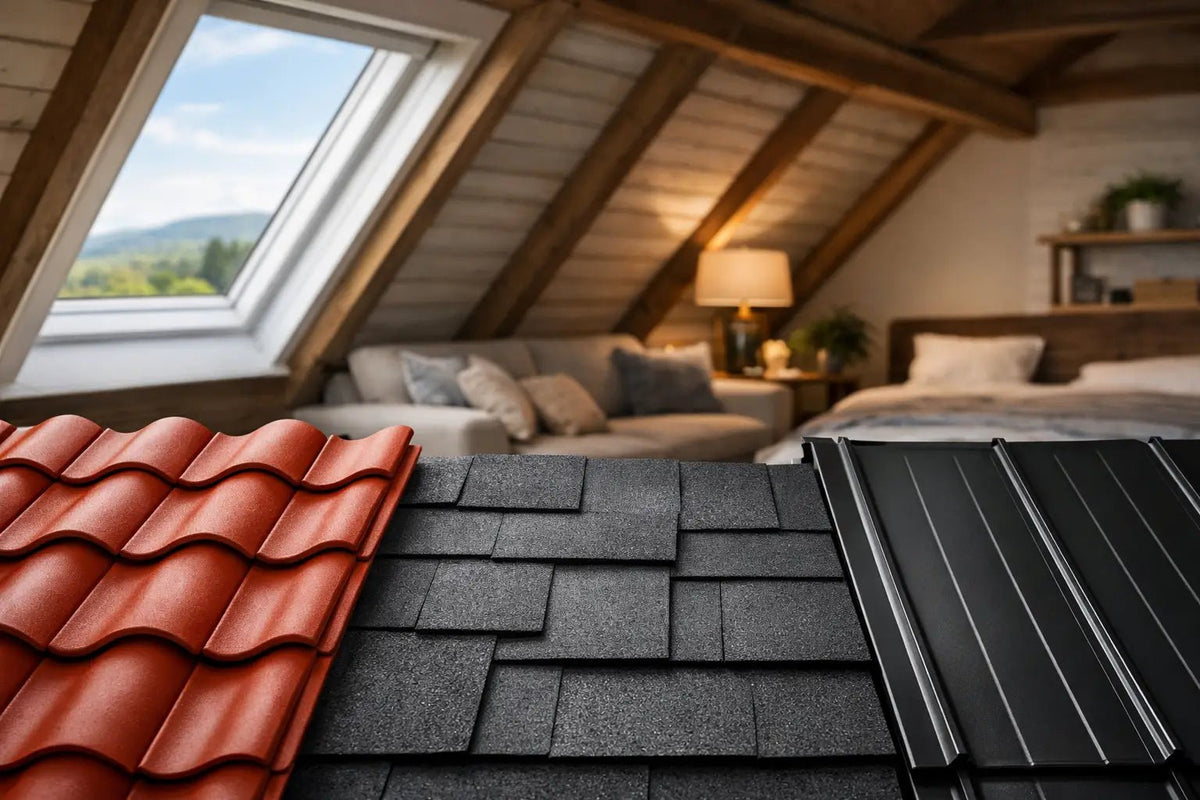
An attic can be well insulated and still have problems with condensation, a musty smell, or heat loss. Often, the cause isn't the thickness of the insulation, but the wrong choice of the layer that protects it. The question "what roof underlay to use" doesn't have a single answer, because the film is chosen based on its position in the system, the type of roof covering, ventilation, and how the loft or attic will be used.
Under a covering of metal sheeting, metal tile, ceramic tile, or shingles, a membrane must manage the water coming from outside and the vapor generated indoors. Toward the room, another layer must limit warm vapor from entering the thermal insulation. When these roles are reversed, or when one of the layers is missing, the roof structure becomes vulnerable.
What roof underlay is installed under the covering?
On the outer side of the thermal insulation, directly under the roof covering, a highly vapor-permeable anti-condensation film is typically used, also called a breather membrane. This is the layer that protects the rafters, the sheathing, and the mineral wool from accidental water infiltration, drifting snow, and condensation that can form on the inner face of the roof covering.
A high-performance breather membrane must be waterproof from the outside but permeable to vapor moving from the insulation toward the outside. The principle is simple: if a small amount of moisture reaches the wool or the wood, the system must allow it to escape, not trap it between layers.
Don't confuse an anti-condensation roof film with a simple polyethylene sheet. A plastic sheet can stop water, but doesn't provide the controlled vapor diffusion needed in an insulated roof. Installed under the roof covering, it can trap moisture in the roof structure and encourage wood decay, mold, and a loss of the insulation's performance.
Why does the Sd value matter?
For roof films, the Sd value indicates the material's resistance to vapor passage. The lower the value, the more easily the membrane lets vapor escape. For the outer layer of an insulated roof, a highly vapor-permeable membrane with a low Sd is usually needed.
However, Sd isn't the only criterion. Also check tear resistance, UV stability during the construction period, temperature behavior, the material's weight, and compatibility with the roof pitch. For a metal roof, where the risk of condensation on the underside is higher than with other coverings, membrane quality and correct ventilation become even more important.
The vapor barrier is installed toward the interior
On the warm side of the thermal insulation, that is, toward the attic room, the vapor barrier or a smart vapor control membrane is installed. Its role differs from that of the anti-condensation film: it reduces the amount of water vapor from the home that can enter the wool layer and condense in the cold zone of the roof.
The air in a house always contains moisture. Cooking, showers, drying laundry, breathing, and even plants raise the indoor vapor level. In winter, this vapor tends to migrate outward. If it passes through the finish and the insulation uncontrolled, it can meet a zone cold enough to turn into water.
Water trapped in the wool reduces its insulating capacity. In wood, it can maintain moisture levels that encourage mold and decay over time. That's why an effective vapor barrier isn't just a film installed on a wall or on the rafters — it's a continuous, correctly sealed layer.
Seams must be taped with compatible tape, and penetrations for cables, spotlights, pipes, or ducts must be carefully sealed. An excellent film, perforated by installers and left unsealed at the edges, no longer delivers predictable performance. In reality, many condensation problems are sealing problems, not just material problems.
When do you choose a smart vapor control membrane?
In livable attics, renovations, and roofs with a complex structure, a smart membrane can be a safer choice than a classic vapor barrier. This type of material adapts its behavior to the humidity level, limiting vapor entry in the cold season and allowing controlled drying of the structure when conditions permit.
It's a useful solution especially where there's a risk of residual moisture in the wood, where every existing layer can't be perfectly verified, or where the roof has hard-to-ventilate areas. It doesn't remove the need for correct installation, but it provides an extra technical margin in a system that must function for years.
For homeowners converting an attic into a loft, the difference is felt directly in comfort. A dry structure supports effective insulation, reduces the risk of cold drafts, and helps maintain a more stable temperature in summer and winter.
Not every roof has the same configuration
The choice of film depends on how the roof is built. A ventilated roof, with an air space between the membrane and the covering, manages moisture and high temperatures better. Counter-battens and battens aren't simple fixing elements: they create the channel through which air flows from the eaves to the ridge.
On a roof with sheathing, the membrane can be installed over the continuous support, depending on the roof covering's technical solution. On a roof without sheathing, the membrane is stretched over the rafters and held in place with counter-battens. In both cases, the overlaps, the direction of installation, and water drainage toward the eaves must be followed exactly.
For an unheated attic, the strategy can be different. If the thermal insulation is placed on the top-floor ceiling, the roof above doesn't function like a livable attic. Here, the focus is on ventilating the attic and protecting the covering, while vapor control is designed at the ceiling level. Don't automatically copy the detail of a livable attic when you're only insulating the house's ceiling.
Mistakes that compromise the roof film
The most common mistake is installing the vapor barrier on the cold side of the insulation. This traps moisture exactly where it needs to escape. Just as risky is using a breather membrane on the interior side, as if it could replace the vapor barrier.
Another problem occurs when the anti-condensation film is left too taut or, conversely, too loose. The membrane needs controlled installation, with correct overlaps and no areas that can collect water. Holes made by nails, staples, or fasteners must be managed through the recommended installation system, not ignored.
Finally, ventilation shouldn't be treated as an optional detail. Even the best membrane needs a functional path for evacuating vapor. Blocked eaves, an unventilated ridge, or insulation pushed into the air channel can cancel out the function of the entire system.
How do you choose the right system for your project?
Start with three concrete questions: will the attic be heated, what type of roof covering do you have, and where is the thermal insulation located? Then check whether the roof has, or can accommodate, a continuous ventilation gap. This information determines the type of exterior membrane and the interior vapor control solution.
For a correctly insulated roof, the system works as a whole: roof covering, ventilated space, breather film, thermal insulation, vapor control membrane, sealing, and interior finish. Choosing a single film without considering all the layers may seem cheaper at first, but can lead to costly work after the first cold season.
Isoflect Insulation recommends selecting materials based on the installation area and the measurable function of each layer, not on generic names. A technical discussion before ordering can quickly clarify the insulation thickness, the position of the films, the sealing tape needed, and the actual surface to be covered.
A dry roof isn't achieved with a single "good" film, but through a smart, sealed, and ventilated system. If the details are settled before installation, the attic has a real chance of delivering absolute comfort and lasting energy performance, not just a nice-looking finish.