
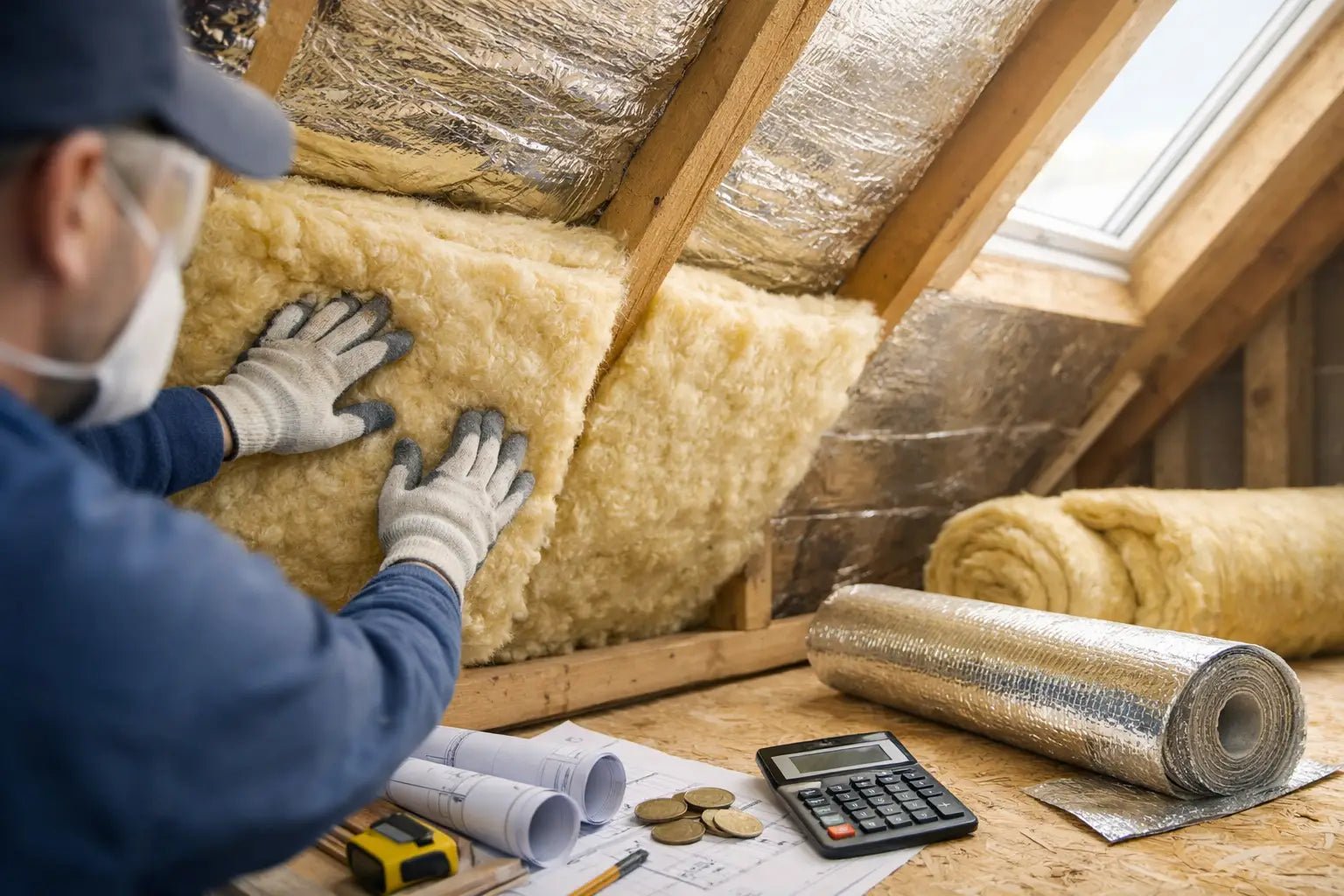
An attic can lose heat quickly in winter and overheat in summer, even if the roof looks flawless from the outside. The question "how much does attic insulation cost" doesn't have a single answer, because the final price depends less on the simple surface area and more on the chosen system: the thermal insulation layer, the vapor control membranes, joint sealing, the structure's thickness, and labor.
For a homeowner converting an attic into a livable space, the cheapest option per square meter can become the most expensive one after a few seasons. Condensation hidden in the roof, drafts through joints, and compressed or poorly installed thermal insulation affect comfort, energy consumption, and the health of the structure. A proper budget must be calculated for the assembly that works together, not for a single material.
How much attic insulation costs per m²
As a planning benchmark, insulating an attic can start at around $12-20/m² for basic materials applied in a single layer, and can reach $35-70/m² or more for a complete system, with high-performance insulation, membranes, sealing tapes, and correctly resolved details. Installation cost is added separately and varies widely depending on access, roof geometry, region, and the complexity of the job.
For readers used to imperial units, one square meter equals about 10.76 sq ft. For example, a $40/m² materials budget is equivalent to roughly $3.72/sq ft. These figures are indicative, not a fixed quote: actual prices change depending on thickness, product type, quantity, and project requirements.
An 80 m² attic doesn't always mean 80 m² of insulation. In a sloped roof, you calculate the area of the slopes, the gable walls, and, depending on the case, the ceiling or floor. Add 5-10% for cuts and waste, especially if there are dormers, chimneys, skylights, or many changes in direction.
What actually goes into the price of a properly insulated attic
The real cost isn't set only by the thermal wool or a reflective film. A reliable system must limit heat transfer, manage water vapor, and stop the air leaks that reduce the performance of the whole job.
The thermal insulation layer and its thickness
The thermal insulation material usually takes up the largest share of the budget. Price is influenced by the Lambda thermal conductivity, thickness, density, moisture behavior, and its contribution to sound insulation. Insulation with a lower Lambda can offer better thermal resistance at the same thickness, but that's not automatically the ideal choice if it doesn't fit the existing structure and the rest of the layers.
In livable attics, the thickness available between the rafters is often insufficient for the desired comfort level. That's why the technical solution can include a layer between the rafters plus an additional layer under the rafters. The second layer reduces thermal bridges created by the wood and can improve both winter comfort and sound protection.
Membranes for vapor, condensation and roof protection
A membrane isn't an optional accessory chosen for the lowest price. On the interior side, vapor control helps prevent uncontrolled moisture migration toward the cold zone of the roof. Under the roof covering, a breather or anti-condensation film protects the system against accidental moisture and allows proper vapor management, depending on the roof's configuration.
Choosing the wrong membrane can lead to interstitial condensation. This isn't immediately visible on the finish, but it can dampen the wood, reduce the insulation's efficiency, and encourage mold. In a responsible budget, membranes must be evaluated by function, not just by the price of the roll.
Sealing: small cost, big effect
Overlap tapes, sleeves for cables and pipes, adhesives, and joint tapes seem like minor expenses. Still, they make the difference between a vapor barrier that's continuous and one that's perforated at every service penetration. Warm, humid air doesn't need a large hole to reach the roof.
In a well-executed job, every joint, corner, wall junction, and penetration is treated as part of the system. This is where reliable, predictable performance is gained, not from general promises about a "better" material.
Structure, finishes and labor
If the attic is old, the budget may include repairs to the rafters, wood treatment, correcting ventilation under the roof covering, or replacing deteriorated elements. For a livable attic, the framing for cladding, drywall board, electrical work, and finishes are often added on top. These costs aren't the insulation itself, but they must be planned for from the start.
Labor can cost almost as much as materials on projects with complicated geometries. A simple roof, easily accessible from the inside, is faster to insulate than one with many skylights, chimneys, exposed beams, and hard-to-reach areas. Ask that the installation quote clearly specify the layers, thicknesses, and sealing operations, not just a single total for the job.
Three possible budgets for the same surface area
For an attic with roughly 100 m² of insulated area, the differences become easy to understand. A basic project may aim only to reduce heat loss, with one thermal insulation layer and limited detailing. It looks attractive at first, but you need to check carefully whether it includes vapor control and continuity at the joints.
A balanced project includes thermal insulation at the right thickness, a membrane suited to its position in the system, and sealing accessories. For most finished attics, this is the level where the ratio between investment, comfort, and technical risk is best.
A premium project aims for absolute comfort: an optimized layer sequence, reduced thermal bridges, tight control of air and vapor, better sound performance, and carefully handled details for skylights, chimneys, and installations. It costs more, but makes sense for permanently occupied homes, exposed roofs, or renovations where later access to the structure will be difficult.
How to reduce cost without reducing performance
Smart savings don't mean eliminating the membrane or the sealing tapes. It means choosing a correctly sized system and avoiding materials bought in excess, insufficient thicknesses, and redone work. Careful measurement of the surface, checking the structure before ordering, and planning installation routes reduce material waste and installation time.
It's also useful to choose products that perform multiple functions when the project allows it. A multifunctional solution can contribute to thermal protection, condensation control, sealing, and acoustic comfort, reducing the number of layers or operations needed. Not every project needs the same configuration, and compatibility between products remains essential.
Questions to ask before requesting a quote
Before comparing prices, determine whether the attic will be permanently occupied, what thickness is available, whether a film already exists under the roof covering, and where the cables, pipes, or HVAC ducts will run. Also check the condition of the wood, the roof's ventilation, and any signs of past leaks. The answers change both the materials needed and the labor cost.
A comparable quote should state what surface area it covers, what thickness each layer has, what Lambda value the insulation offers, what type of membrane is planned, and whether sealing accessories are included. If one of the quotes omits these details, a lower total may be hiding missing layers.
For a quick, safe choice adapted to your actual situation, a system configurator or technical consultation can turn a long list of products into a coherent package. Isoflect can help match materials to the surface, structure, and comfort goal of the attic.
The right price isn't the lowest number on the quote, but the cost of a system that stays dry, sealed, and efficient after years of temperature swings. Start from the roof's details, calculate all the layers, and leave room in the budget for the sealing that protects the investment.